
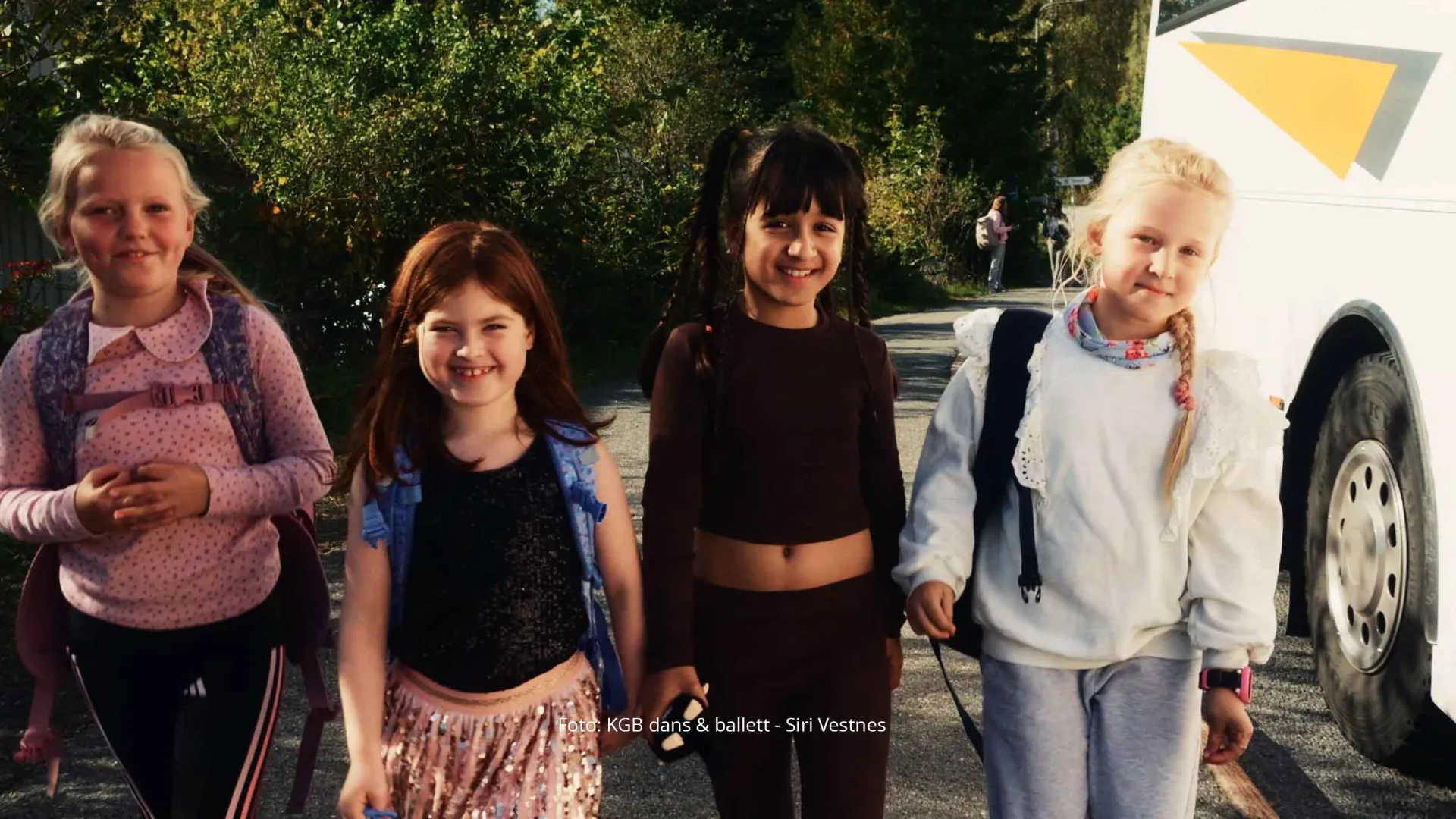
Transport to and from activities is a barrier that most are familiar with, but very few have solved. 59 percent of Norwegian municipalities believe transport is a major barrier to participation in leisure activities, and in 2019, Save the Children found that 86 percent of municipalities had no transport arrangements to ensure that children and young people could get to activities.
In Ålesund, we are part of a project that tries to solve this. Together, the sports council, the municipality, and local businesses ensure that children and young people can get to and from activities. There is no definitive answer, but it may be a recipe that works in several places.
https://www.nimmo.app/no/artikler/nytt-initiativ-i-alesund
What distinguishes Ålesund from what we have seen before is that no one bears the responsibility alone.
The Sports Council in Ålesund is the project owner and contract partner with the transport provider and us. This provides a clear owner, which simplifies communication and distribution of responsibilities.
The municipality contributes resources, anchoring, and legitimacy. This ensures that the service does not depend on the enthusiasm of individuals. It also reaches a broader audience than the sports council would have done alone. Additionally, the municipality can contribute funds from grant schemes such as inclusion funds from Bufdir.
A local savings bank contributes to the transport costs through community funds. Getting exposure for contributing to more children and young people getting to activities is very positive for businesses.
Nimmo is not one of the three parties. We do not drive, do not own vehicles, and do not finance. We are the tool they use to coordinate everything, so that one vehicle can transport many children together instead of many parents driving separately.
This is the question we often receive, and we believe we have a good answer.
A clear owner. Someone must be a contract partner and make decisions. Without that, it stops regardless of how good the intentions are.
A municipality that is involved. Not necessarily with money from day one, but with an anchoring. A project that only exists in volunteerism disappears when key individuals leave.
A local funding source. In Ålesund, it is Sparebanken Møre. In other places, it could be a foundation or a local business community that wants to contribute to something concrete.
Enough volume in one place. The model works best where several children are going the same way at the same time. Regular, recurring activities are easier to coordinate than scattered individual trips.
If any of these are missing, it becomes more difficult. Not impossible, but more challenging.
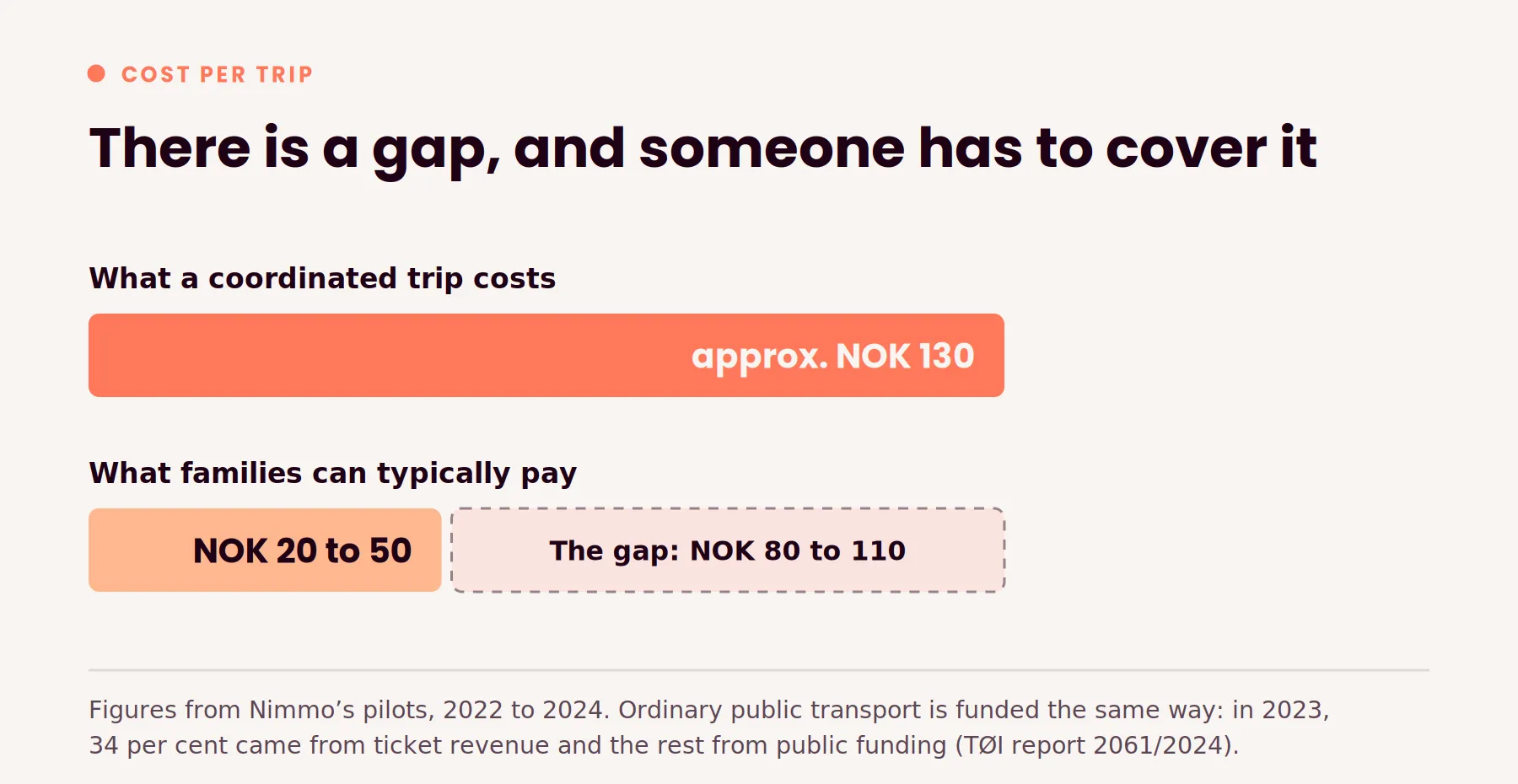
A trip with shared transport costs about 130 NOK per trip. The willingness to pay from a family is around 20-50 NOK per trip based on pilots we have conducted in Molde. The gap does not disappear just because one wishes it strongly enough. But if more people travel together, the gap becomes smaller.
When eight parents drive separately, it costs eight trips. When the same children are picked up with one vehicle, it costs one. At KGB dance & ballet, our own operational data from August to December 2025 shows that the cost per trip was under 90 NOK. This is due to a high occupancy rate on the bus. In other words, many kids were on the same trip.
https://www.nimmo.app/no/artikler/hva-skjer-nar-behov-styrer-transporten
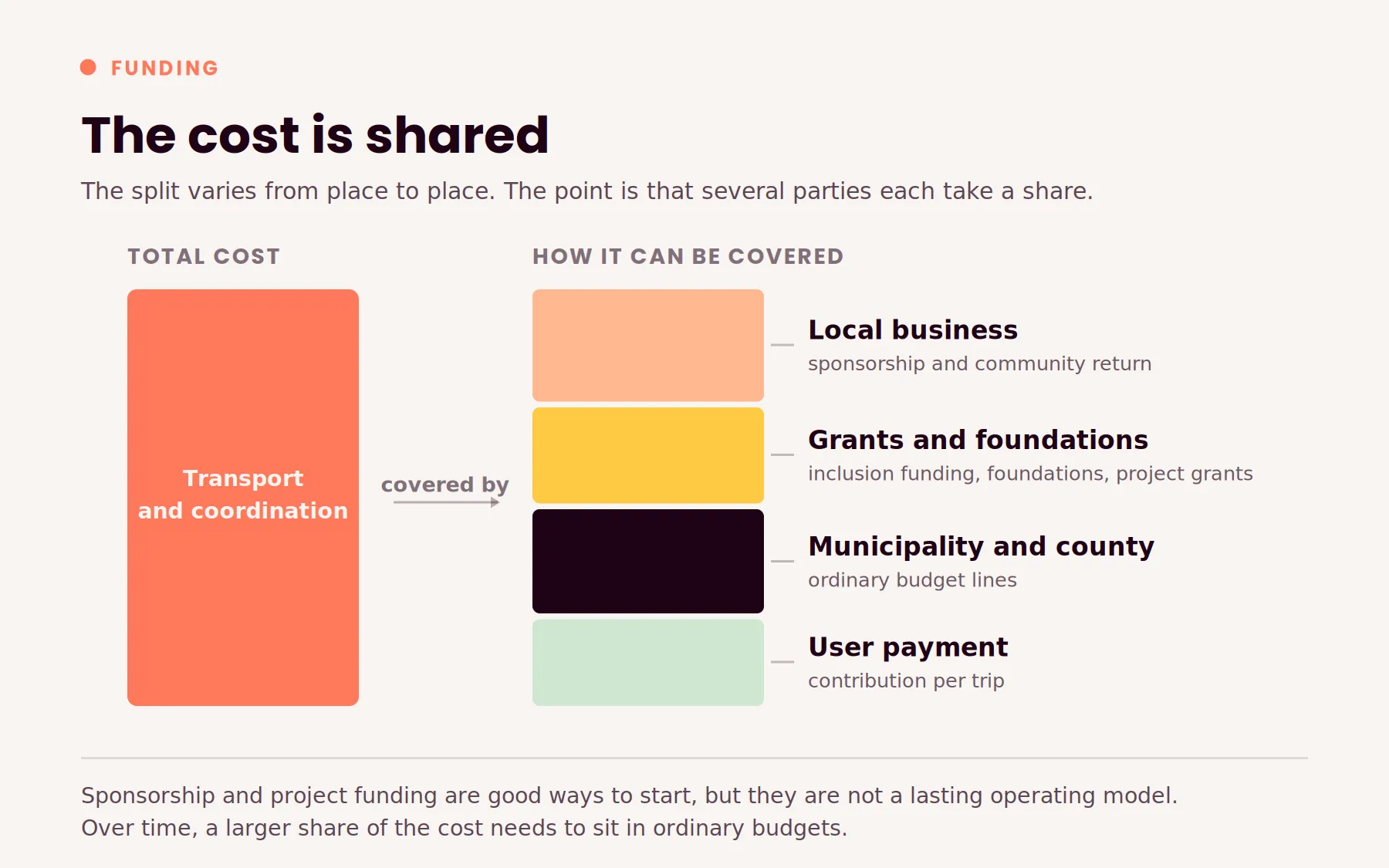
User payments cover part of it. Grants and funds cover the inclusion part. Local businesses can take part. Over time, the municipality and county municipality should cover part of it through regular budgets.
The distribution varies from place to place. The point is that several take their part, and that someone coordinates so that the parts fit together.
Sponsorship funds and project funds are good to start with, but they are not a sustainable operational model. A service that depends on a new application every year is living on borrowed time. For this to become permanent, a larger part over time must be in regular budgets.
Experiences from Ålesund and other places have given us more knowledge about who should be involved to create good, viable transport services. The goal is for as many children and young people as possible to participate, regardless of their parents' social and economic situation.
Are you in a sports council, a sports district, or a municipality and curious about whether this can be implemented in your area? Get in touch, and we can have a conversation and share experiences and opportunities.